The Frog
In Switzerland, Article 20, Annex 3 of the Ordinance on the Protection of Nature and Cultural Heritage (January 16, 1991) states that all amphibians (frogs, toads, salamanders, newts) are protected by the law. Thanks to nature conservation associations, as well as federal, cantonal, and local initiatives led by herpetologists and communities, schools and citizen engagement, several efforts have been made to put this principle into action through the identification of endangered species, the rescue of amphibians, the mapping and conservation of breeding sites and dispersal routes, the construction of ecological corridors, temporary ponds, and “blue-green” infrastructures.
Despite this mobilization, 15 of the 19 amphibian species mapped in Switzerland “are considered critically endangered, four least concerned, and one regionally extinct”. A trend that resonates with planetary dynamics: according to the 2023 “State of the World’s Amphibians”, 41% of amphibians are globally endangered, with habitat loss, epidemics of infectious diseases, and climate change being the main causes of this. In Switzerland, the main reason for the population decline of amphibians is the destruction of their preferred habitat, wetlands: since 1850, 90% of them have been drained, or wiped out by urban or agricultural development. Amphibians are the most vulnerable class of vertebrates worldwide, a revealing casualty of the ongoing sixth mass extinction. Although they have been around for 370 million years and survived four previous mass extinctions, homo sapiens, a species that emerged from natural evolution only 300,000 years ago, is now exterminating them.
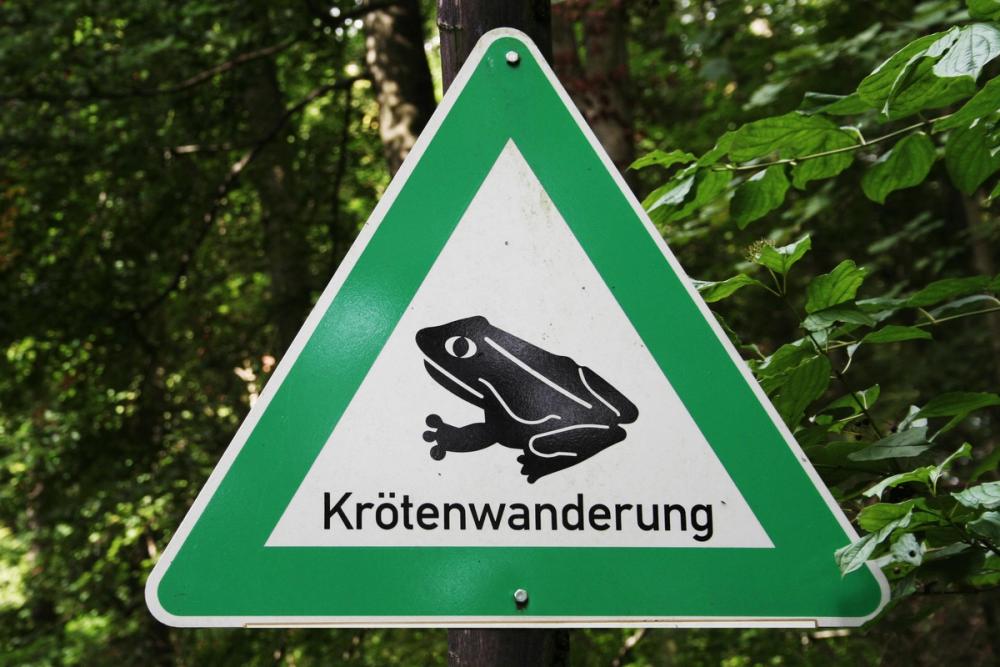
Road signs like this should protect amphibians from being run over by cars during their spawning period. © Momo_2210 (via pixabay).
The astonishing diversity, ecosystem-specific life cycles, permeable skin, dual life in water and on land, and constant exposure to a wide variety of environments make amphibians a revealing case study for both ecology and critical theory. Almost 9,000 amphibian species are currently known, and about 150 new ones are described each year. Their physiological flexibility, genetic adaptability, and developmental plasticity have allowed them to survive and thrive in heterogeneous ecosystems, from tropical forests to dry deserts and frozen tundra. Yet their unique ability to integrate closely with local biomes, which has served them well throughout evolutionary history, has now become a liability. The key strength of these biological prodigies—the intimate contact with the environment through cutaneous respiration, complex caring behaviours, and ectotherm —is making them vulnerable to human-induced modifications of the environment. When a frog lays eggs in ponds, develops into a larva, and then embarks on a terrestrial life involving migrations and hibernation, a hostile and simplified urban or agricultural environment in a changing climate regime disrupts its life cycle.
In this contribution, I will not review the achievements and limitations of the increasingly am-phibian-conscious practices of Swiss society. Instead, I will devote myself to a reflection on a single, concrete case of contact between the amphibian world and the world modified and built by humans. An encounter that I witnessed during a field trip at the Werdhölzli wastewater treat-ment plant of Zurich on September 21, 2024. How generalizable this example might be, I cannot say. I therefore leave it to the readers to extract from these observations any insights that may be useful for their own worlds.
The context for this experience was a research project on “ecosocial transitions” carried out jointly by Colombian and Swiss-based researchers. Together, we visited the Werdhölzli sewage treatment plant to study the biosocial implications of urban infrastructures. While taking notes on the technical processes of wastewater treatment, we noticed a few seemingly out-of-place low-tech objects: a series of small wooden huts housing unassuming closed plastic boxes.
Our guide, a patient and proud employee of the Werdhölzli, explained that, if we were lucky, we might catch a glimpse of the amphibians that had managed to escape the cogs and chemicals of the treatment plant. And indeed, with a mixture of astonishment and pity, we spotted a survivor tucked in a corner of a plastic box: a lonely grass frog. We had just encountered one of the few amphibians that, although severely debilitated, had not shared the fate of the 15,000 annual victims of Zurich’s drainage system.
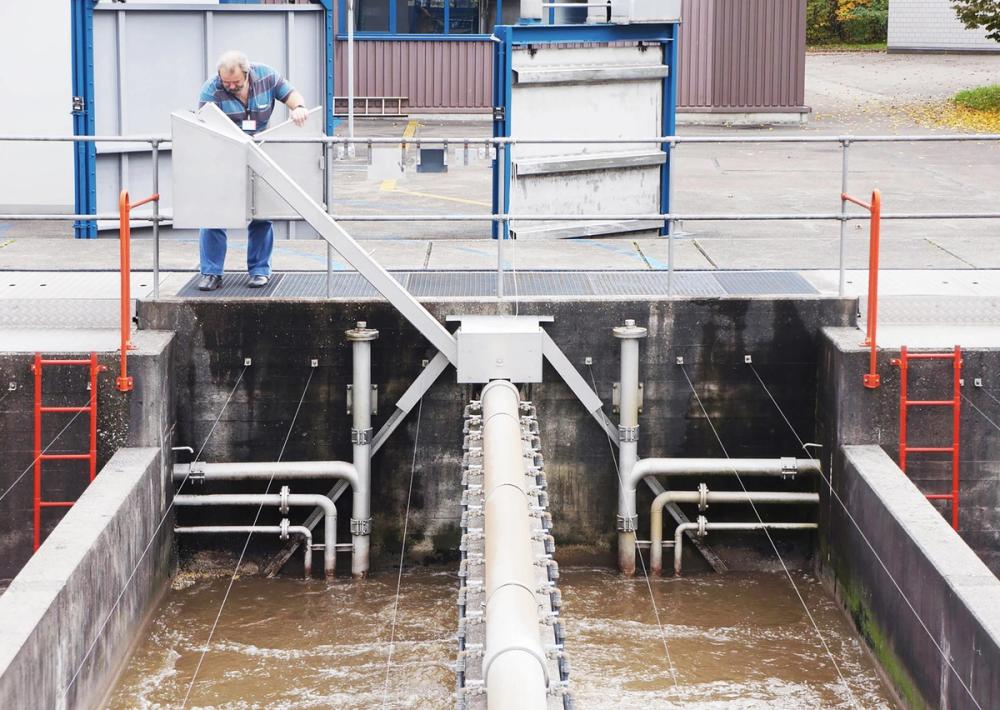
Amphibian rescue infrastructure at the Werdhölzli sewage treatment, Zurich. © Büro für Wildtierarchitektur.
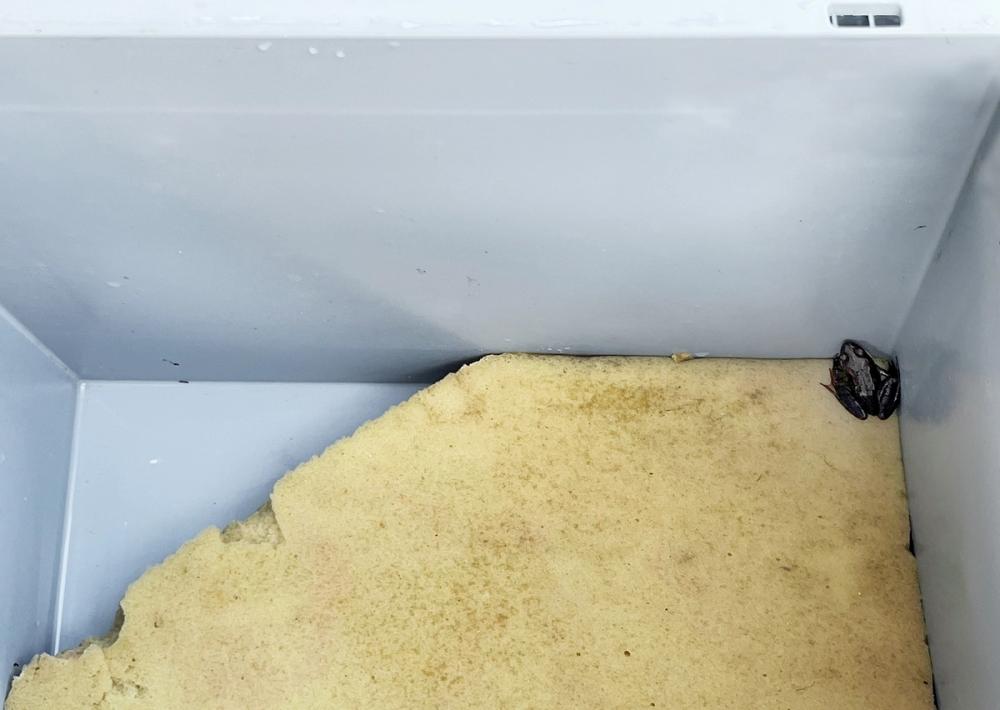
Amphibian rescue infrastructure at the Werdhölzli sewage treatment plant in Zurich. © The author.
The future of this frog was soon explained to us: it would be placed in a refrigerator along with hundreds of other amphibians that, by some means, had not succumbed before reaching their plastic rescue containers. With the arrival of spring, all these “fortunate” animals would be brought out of hibernation and transported by van to woods on the outskirts of the city, where they might eventually survive, provided they are not caught by predators, smashed by cars, or swallowed by water collection manholes.
The Plant
The Werdhölzli sewage treatment plant along the Limmat is the largest facility of this kind in Switzerland. It treats all the city of Zurich’s wastewater, an average of 2,200 liters of wastewater per second. After five stages of purification, this largely automated state-of-the-art facility discharges the cleaned water back into the Limmat river.
A paradigmatic feature of contemporary urban life, the Werdhölzli revealed itself during our visit as a site also inhabited by amphibians, whose foraging and reproductive habits make them vulnerable to the drains, pipelines, pumps, tanks, filters, grit chambers, and chemicals involved in the collection, conveyance, and treatment of urban wastewater. Caught by the drainage system, amphibians are the primary group of vertebrates drawn into this essential apparatus of hydro-modernity. The circumstances that lead them to this industrial facility are poignantly described in a document released by the city of Zurich, written in a prose that does not conceal empathy for the cruel fate faced by these creatures:
“During their seasonal migrations, thousands of amphibians cross through Zurich’s urban areas. Roads pose a particular danger: curbstones with edges higher than 3 cm act as barriers that strongly influence the animals’ movements. Amphibians tend to follow the curb until they find a gap. In their search for a crossing point, they are left exposed to traffic, weather, and predators. In most cases, however, they are funnelled directly into street drains. Once trapped inside, they often die from exhaustion. If flushed through the sewer system or sucked out during drain cleaning, they reach the Werdhölzli sewage treatment plant in a severely weakened state. Surveys conducted by Green City Zurich (GSZ) between 2010 and 2012 revealed that at least 15,000 amphibians die each year in the drainage system.”
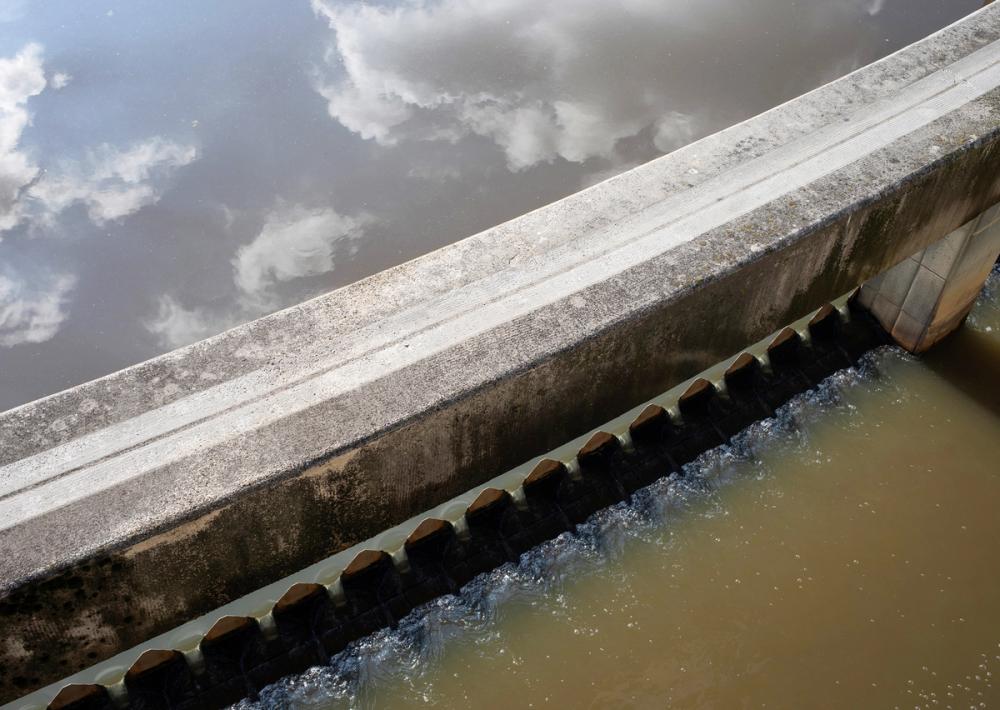
Inside the Werdhölzli sewage treatment plant, Zurich. © The author.
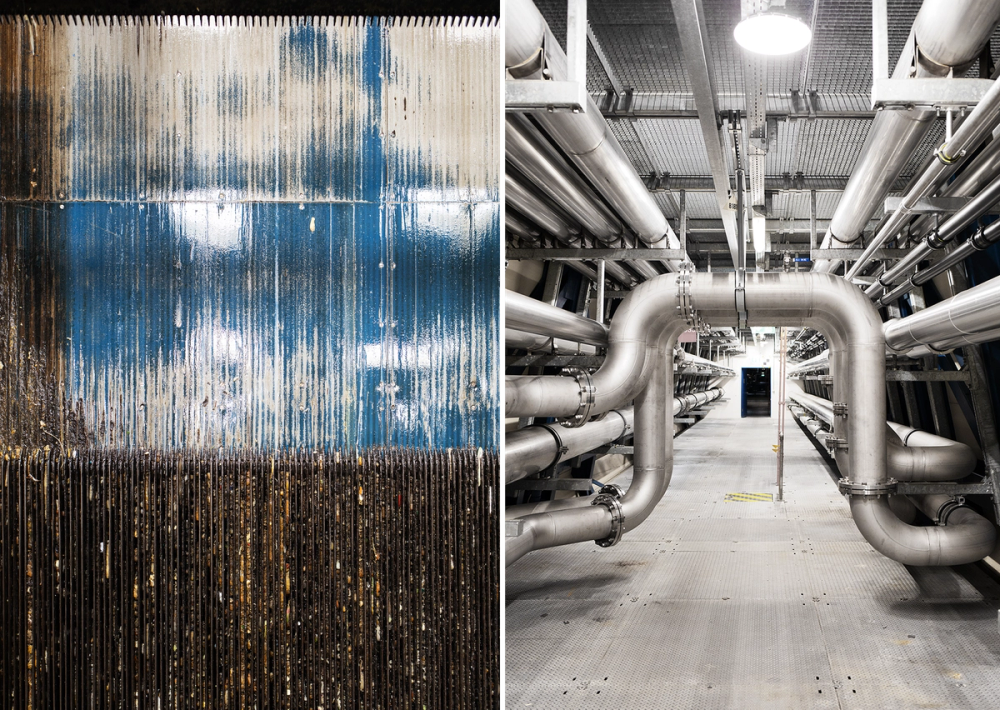
Infrastructure detail at the Werdhölzli sewage treatment plant, Zurich. © The author.
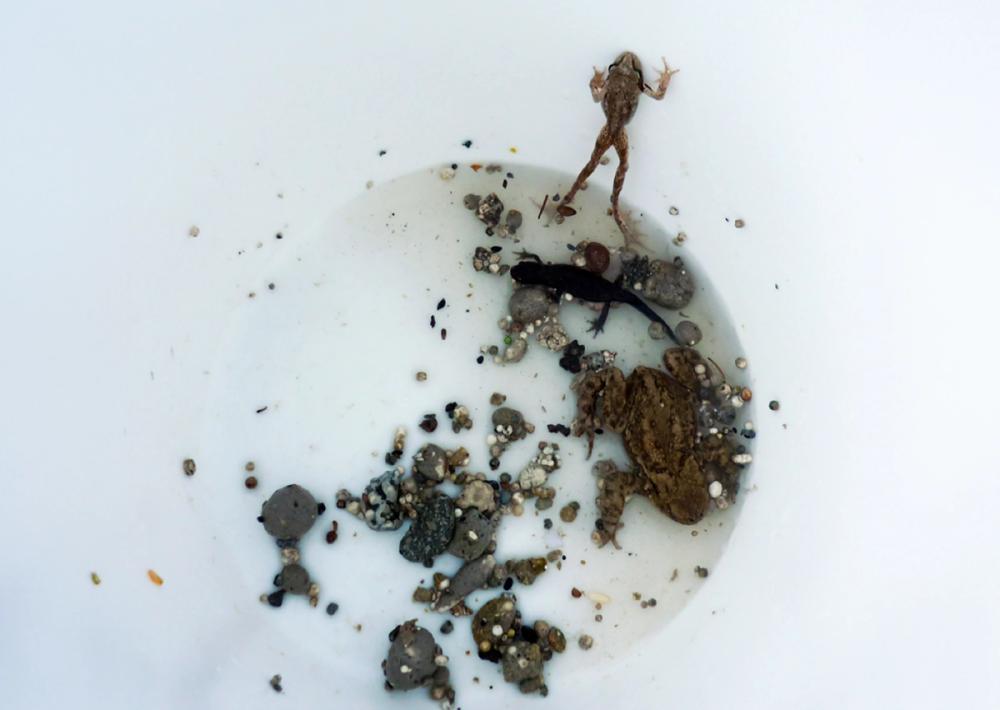
Various collected amphibians. © Büro für Wildtierarchitektur.
As explained by the Department of Civil Engineering and Waste Management of the city of Zurich, a set of measures were introduced in 2013 to reduce the impact of urban drainage systems on amphibians. Two of these solutions were tested in 2014: amphibian ladders, which provided a route for animals to climb out of drains, and surface ramps, which helped them cross curbs before falling in. The pragmatic answer to the amphibian extinction crisis offered by the caring employees of the city of Zurich is an infrastructure within another infrastructure. We can now understand what we experienced: instead of joining the statistics of dead amphibians, the grass frog we observed in the box had taken advantage of an escape route offered by the ladders installed at the Werdhölzli.
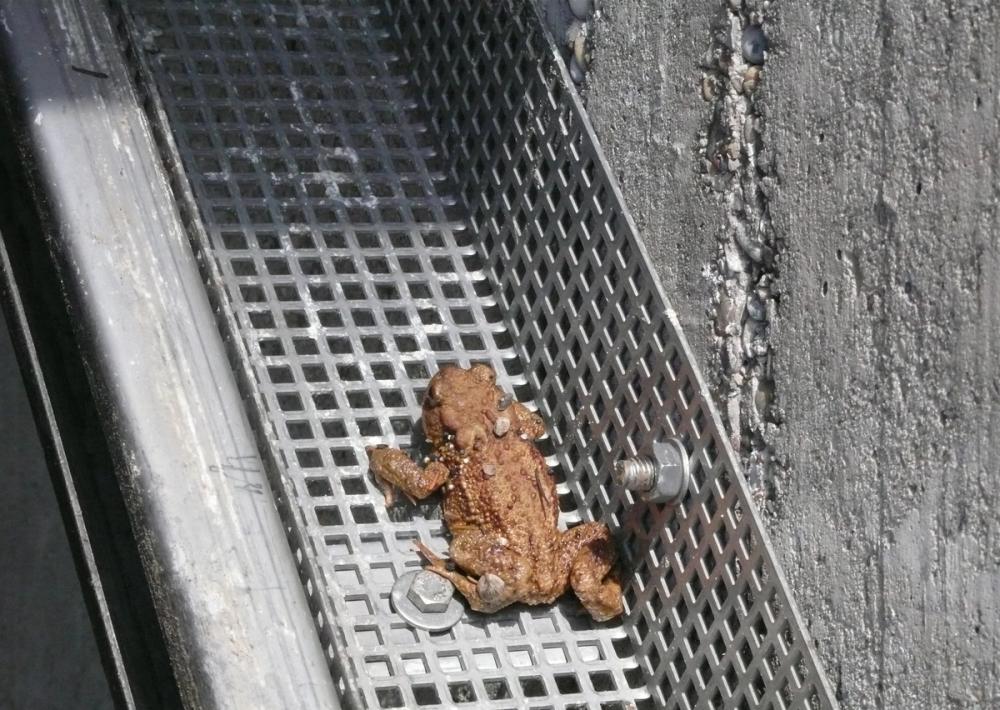
A common toad climbing an amphibian rescue construction at the Werdhölzli sewage treatment plant in Zurich. © Büro für Wildtierarchitektur, 2011.
The Contact Zone
In the urbanized world, infrastructures of all kinds sustain, shape, and regulate biological life: from water supply and sanitation to transportation, energy, communication, waste management, and health and safety systems. It is therefore not surprising that solutions to ecological problems are usually sought within these pervasive physical and social networks of pipes, cables, sensors, energy, data sets, and management protocols. Yet, in an age of climate change and terricides, the modernist view of infrastructure as an unconditional, emancipatory driver of progress has lost its political and imaginative force. Dams and canalized rivers intensify floods and drive species extinction; the technopolitical system of the fossil economy threatens life at a planetary scale; and the global extraction and concentration of people, materials, and energy in urban areas destabilize environments across continents. Once regarded as a purely technical matter for engineers and planners, infrastructure has become a central concern for the humanities, the social sciences, and the arts, raising new questions. In the case of the sewage treatment plant, what happens when amphibians enter the apparatus of contemporary urban water management? What can we learn from this intersection of sewage, engineering, and animal mobility?
An answer may lie in the concept of “pluriversal contact zones”. Theorized by Marisol de la Cadena and Arturo Escobar, this term refers to physical and symbolic sites where “divergent worlds” meet: knots in space-time where actions, practices, and knowledges “co-exist in an encounter replete with tensions” (35). The examples favoured by de la Cadena and Escobar are taken from indigenous politics. For instance, when a coalition of urban environmentalists and indigenous peasants came together in Cutzco, Peru, to defend a mountain called Ausangate against a mining corporation who saw it exclusively as a repository of ores, what emerged was a pluriversal contact zone (32). Through the convergence of heterogeneous interests Ausangate became a “self-excessive” entity: a mountain for the urban activists, an “earth-being” for the indigenous peasants, and a geological resource for the mining corporation. It became an “interest in common which was not the same interest” (32).
The figure of “excess” is the hallmark of pluriversal contact zones. de la Cadena and Escobar describe it as the experience of not knowing, of accepting that some presences escape the cultural and epistemic horizons of some participants of the encounter. For instance, when indigenous populations approach a mountain as a person, or a river as relative, an excess “erupts” and “interrupts” the modern Western practices that treat natural beings as non-living entities (33).
If we extend the interpretative framework of pluriversal contact zones beyond the human and beyond indigenous contexts, also the Werdhölzli sewage treatment plant appears as a pluriversal contact zone, in which human and other-than-human worlds meet. The grass frog and the engineers who designed the escape routes shared an “interest in common which was not the same interest”, since constructing amphibian-friendly ladders in an industrial facility and surviving in a sewage plant are not the same interest. Simply by being there—defenseless in a plastic box, in a transient state between its capture in the sewage system and its hibernation in a fridge—the grass frog in the Werdhölzli produced an excess: it pushed our understanding of urban and animal life outside the confines of modernity, allowing us—the Swiss and Colombian participants in the field trip—to move beyond the logic of contemporary urban management. The grass frog we encountered in the plant did not demand a solution to its inability to survive in a city made of steel and concrete, pierced by hundreds of kilometres of pipes; and yet it was there, rescued by its own reluctant persecutors.
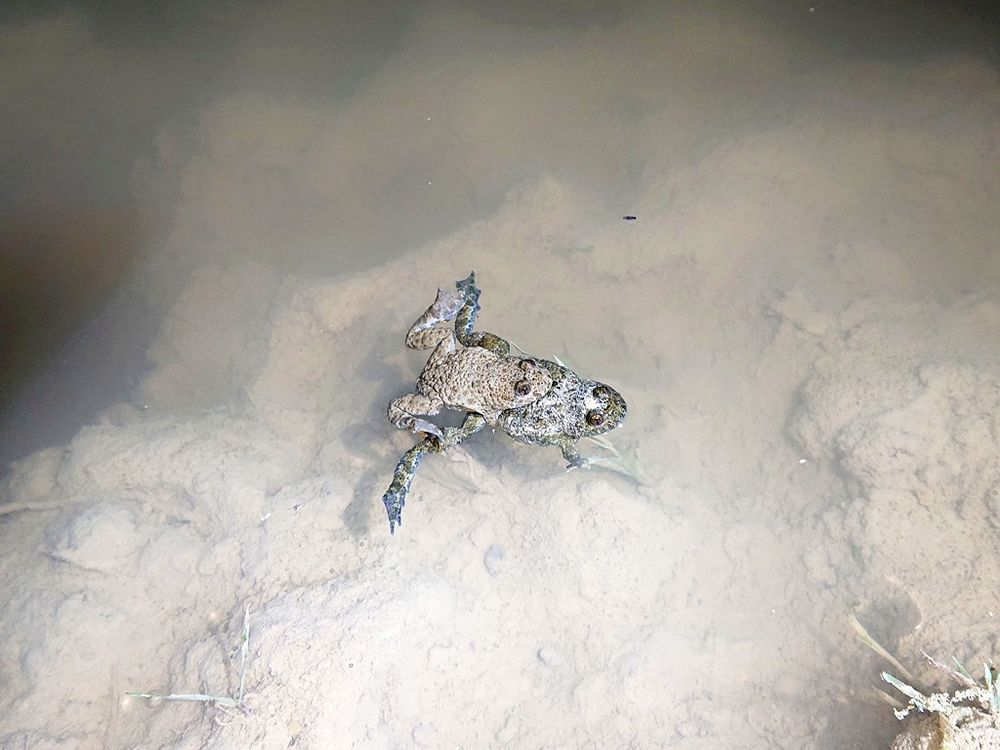
Two yellow-bellied toads (male and female). © Niklaus Peyer.
A crucial insight from de la Cadena and Escobar is that, if only we open our senses, “contact zones proliferate” (32). These encounters reveal “what is beyond the limit of what can be” (30), they carry within themselves the potential to transform the world from within. When something exceeds the boundaries of dominant regimes of life, as in the case of the grass frog of the Werdhölzli, it prefigures “an unknown togetherness which worlds have to learn” (32). What does the “unknown togetherness” of the grass frog in the sewage treatment plant consist of? How can the modern world of engineered sanitation systems and the primeval universe of pond-breeding amphibians come together to reconfigure what exists? At the Werdhölzli, I began to recognize how the technological optimism of the human perpetrators and the vulnerability of the amphibian victims are two sides of the same coin. They share an ecocidal destiny, which renders paradoxical, and even tragicomic, the effort to save amphibians through an add-on infrastructure built within the same infrastructures that condemn them. How can we achieve interspecies coexistence through the very means that makes cohabitation impossible? The unknown togetherness we experienced at the Werdhölzli cannot be separated from the superimposition of pity and hope, of infrastructural torments and amphibian-led planetary utopias. In the automated pluriverse of the sewage treatment plant, a grass frog taught us that the basic forms of organization of our dwelling on Earth must be redesigned, if only to make room to a vanishing 370-million-year-old world of mating songs, epic migrations, and lusting couplings.