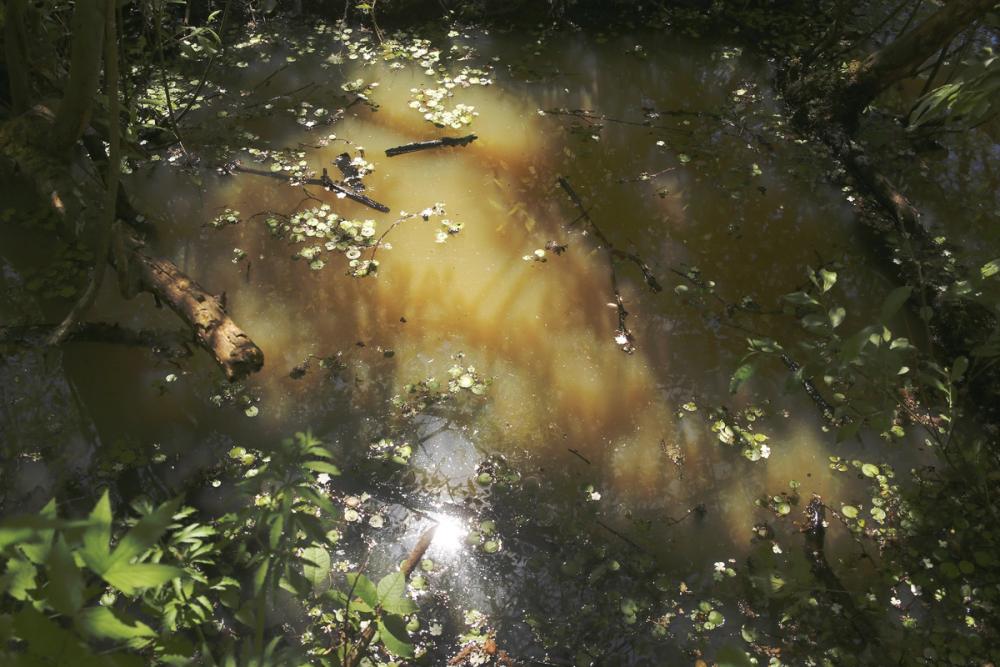
It is the time when leaves have just begun to open up, but what they form is an openwork fabric rather than a thick curtain, letting sounds go through freely. The air stands still, no risk of wind misdirecting the tones. Dry, surrounding noise scratches and pressures the borders of Zakole Wawerskie. The low frequency buzz and roar of the city keep their sonic grip over the wetland, permeating through it, not letting anyone forget about its rush for a second.My ears perk up to any higher, repeating noise. Where is the quiet wooden klok-klok, followed by the hollow gru-gru in response, carried through the water from its under? Common spadefoot toad (Pelobates fuscus), the one that did not get any resonators—hence the low volume of her call—would likely disappear from here with the drying up of the water pool which figures as basin 19 in the inventories. Names like basin 19 mean nothing to me until they become imagined sites of amphibian exodus. I walk carefully now, stopping for at least 10 minutes in places where I imagine blue bodied male moor frogs (Rana arvalis) would hide in the pools, canals and puddles, only to come above the surface in a choir of muffled boiling water or as dogs barking in the distance. No matter how long I wait or how slowly I turn my head (experience of past observations says less than 30 seconds for the full head turn can scare them back under the water surface), nothing comes through.
qu-qu-A-A-A-A—qrUqrU-A-A-A-qr-qr-A——A———A—qrUqru. Suddenly I feel excitement in my stomach and in the back of my throat; only for a second; it takes me no time to understand this familiar, rhythmic rubbery squeak is just geese flying over and not the common toad (Bufo bufo) in their love song quAA’r-qu-qu-QuAa’rr’-qI-qI-QuiAa’r’r’. I walk around, hungry listening; desperately longing to catch at least a non-conclusive but hopeful sign of their presence. Soon, it becomes every leaf that catches the light in the right way. I’m trying to will frogs and toads into existence.
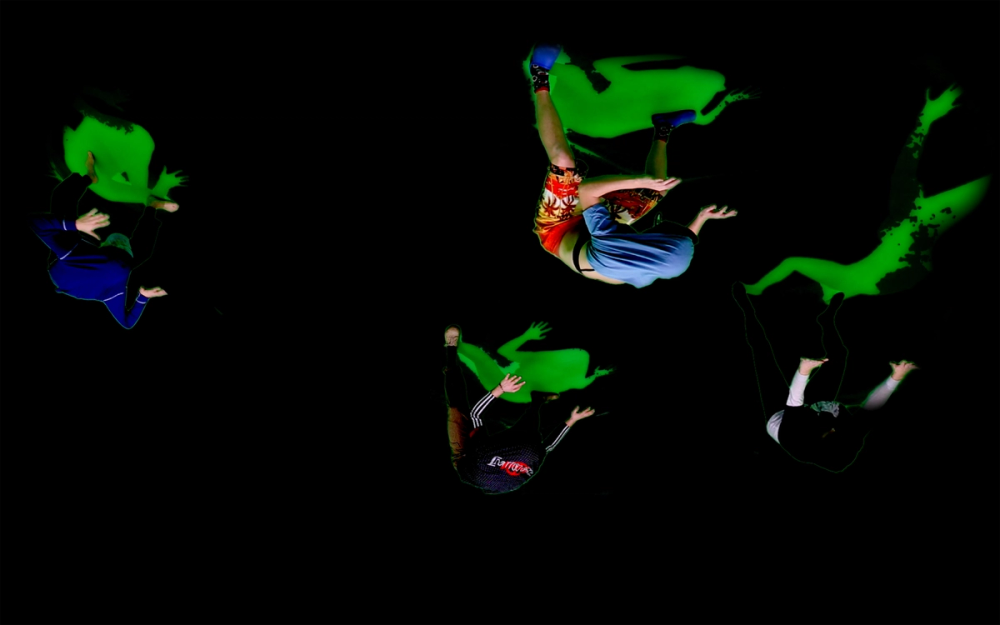
A still from the audiovisual installation The Spirit of a Frog (2025). © Zakole.
Isn’t this hidden damp and feral niche within dense urban development a perfect site for the survival of urban frogs and toads? Surrounded by dense housing settlements, highways and smaller roads, it’s one of the only remaining parts of a once vast floodplain of the Vistula River in Warsaw. It used to be seasonally inundated with water by melting snow and after heavy rainfall. Many parts of its 150 hectares remain surprisingly wet, even when the neighborhood is now completely dried up, with all the ditches rather muddy than flowing. The northern part is a marsh overgrown with an alder carr that can seem like a wild ecosystem far away from any urban settlement. But its soundscape suggests a completely different interpretation than its visual reception. When we come here with new visitors, they often notice a certain unpleasant cognitive dissonance associated with the everyday background noise of the city, which “does not match” their visual experiences of the vast reedbeds, decaying poplars, and slim sedges lying down in shiny green waves.
A 2009 study by biologist Joanna Mazgajska of the Polish Academy of Sciences identified this ecosystem as crucial for the survival of amphibians in the Warsaw metropolitan area. The researcher found six species of amphibians with big populations of common toads (Bufo bufo). She indicated the occurrence of common spadefoot (Pelobates fuscus), which is a rare species in Warsaw, and pointed out that the northern part of the area seems to be a significant refugium of Warsaw’s declining population of ‘brown frogs’ (Rana arvalis and Rana temporaria). But as we come and return on numerous walks during the last five years we only encounter the lonely croaking of the marsh frog (Pelophylax agg.) as it breaks through the noise of the highway and the sounds of the neighborhood.
Even so, the croaking comes not from the core of Zakole, but from a specific spot on its outskirts—an area of flooded investments that are a trace of failed development plans for the wetland. The researcher does not describe this population—maybe this more-than-human home did not yet exist at that time, or perhaps the scientist did not notice it. At the same time other habitats indicated by the author—ditches, ponds and a lake—don’t seem to be a home for amphibians any longer. The soundscape of the space is now composed of conversations of hobby-fishermen and the noise of cars mingling with the rustling of reeds.
All I do is to listen hungrily, and to listen wishfully, chasing sounds from the past. What does it mean to hear someone is not there?
How does it feel to listen to this absence? At this point my ears haven’t given up yet, they try to extend, expand and turn around, maybe I can grow an extra pair?; still holding out, hoping the sounds are there and somehow bypass my limited apparatus. But to stay in this constant anticipation—state of held breath, sharp attention, tense shoulders and limbs, frozen body position—does not really allow for attunement. It turns me into a stone made up of muscle knots and disappointment. Suddenly the search for sonic proximity and connection feels like an act of hunting, with the sole goal of capturing a singular sound, muting out the rest. The absence of sound and the absence of species is a story much more complex than just a diagnosis of whether they are present in a given environment. It’s a tale on changing living conditions, a story of species migrating, losing their habitat, flagging chemical disruptions, or maybe a result of a process beyond our comprehension and observational ability. Sometimes, it can’t be known but can still be felt.
The soundscape undergoes changes, reflecting the changes in the lives of creatures in a given habitat. Even ecosystems with a certain degree of resilience and stability, even those protected by environmental law, are not fixed in time. Following the sound allows us to observe their transformations. This is particularly revealing for those transformations that remain invisible, hidden in the nooks and crannies of ditches and green edges or in the depths of soil. The apparent discrepancy between the image and sound of Zakole is not only a matter of clashing orders. It is also a matter of modifications taking place at different rates. Since the decline of agriculture and the resettlement of Zakole by beavers, we have seen an evolution towards the moistening and rewilding of this area. But listening to it reveals the extinction of species and the growing pressure of the city around it, and unfortunately it seems to be a more reliable prediction of change.
Songs of amphibians during their breeding season are recognized as valid information during scientific monitoring. The Amphibian Conservation Handbook provides specific guidelines for listening to frogs. For example, the grass frog (Ranarana temporaria) is characterized by a short, explosive mating season. You should begin observing sites immediately after the first warming after winter on sunny days (minimum air temperature approx. 10°C, water temperature at least 7°C), when there is no snow cover on land... Where, in turn, the common spadefoot should be searched for after a long period of warmth and during humid weather, at dusk and at night. It is therefore essential to carry out at least one check using flashlights, as the sound is very delicate and hard to hear. These instructions also can be reinterpreted as a guide for attentive observations focused on seasonal changes and times of the day, as well as taking advantage of diverse forms of observation. It can lead to a deeper experience of the ecosystem as a whole.
The Spirit of a Frog, audio, 14'05'' (2025) The frog, once a common sight, now haunts the wetland as a phantom. Perhaps it is our wishful thinking that makes us perceive its presence in the shape of a withered leaf and in the confusingly similar cry of a goosander or a mallard duck. We ask ourselves how do species and ecosystems make it known that they are absent? What form do they return in? What practices of remembering and invoking them can we resort to? With our bodies performing this peculiar ritual of leaping and calling, we recreate the mating songs of frogs, spadefoots, and toads, as we let their spirits pass through us.
A solid layer separating an organism and its fragile guts from the exterior works quite differently for amphibians, as their existence is based on porosity and permeability. Their skin is engaged in a profound conversation with the environment and seemingly invisible to us—humans—even slight changes in chemical composition, temperature, or moisture can make a big difference for them.
As an active respiration organ, amphibian skin is their main apparatus of understanding and processing inputs from the environment. It absorbs oxygen, which enters blood vessels right at the skin surface that will circulate the oxygen to the rest of the body. Many amphibians breathe only through their skin. Imagine being covered with a sponge which deeply ingests everything that touches you. Before anyone finds out, human or more-than-human, you already know and are affected by the toxins directly entering your bloodstream. Thus, amphibians always FEEL the right time to move further to a safer place. They have no casing, no scales, no feathers, no fur nor hair, their eggs have no hard shells – they live by constant fluid exchange with water bodies, blurring the boundaries of a single consolidated organism and the life around it. They can teach us so much about being interconnected with the world.
Since they depend on staying wet to absorb oxygen, they release mucus to maintain that moisture. In a wet environment, the mucous layer persists for several hours since the air moisture compensates water loss. When its water reserves run out in a dry environment the skin can’t exchange gases anymore, resulting in suffocation, dehydration and death.
Several minutes can be a final digit on such a scale of sensitivity and porous existence. The skin, which is a haptic tool for us as humans, is a communication portal for amphibians, a mode of decoding and understanding their surroundings. It is said that they are a „canary in the coal mine” for the ecosystems they inhabit—a biological early warning system which reacts to dangerous changes faster than other organisms. This living bioindicator gives its life in great numbers so we can finally notice the loss and degradation of more-than-human spaces of refuge. Navigating the precious life cycle between aquatic and terrestrial habitats, we shall train our attentiveness to an amphibian scale, stretching between their fragile respiration and mass extinction.
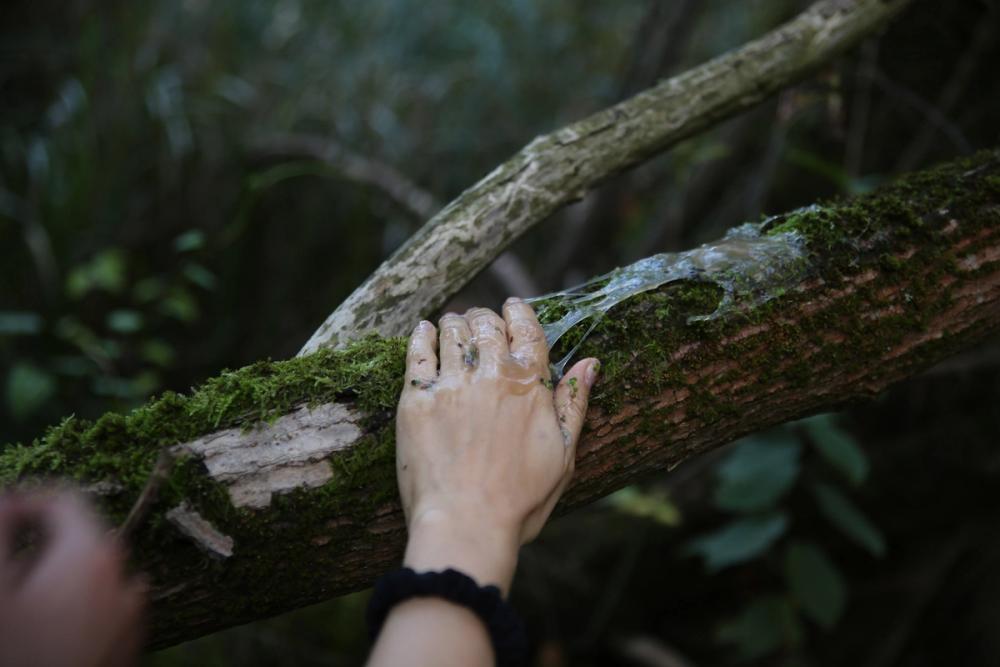
What is it like to have a humid, amphibian skin? A score from field workshops to examine the marsh with a hand covered with linseed lubricant. © Zakole
To hear this absence of species can also mean to notice/register the multitude of life happening despite the change, a reminder of all that is not lost. My body starts to follow and stretch, it quiets down, relaxes; searching for the mode to attune to certain frequencies as it was turning a knob on the radio. As soon as my ears open up, my eyes soften, my pores expand, my whole body becomes a surface of resonance. I can receive signals and tones, including the sound of my own movement and breathing. I think of the full-body hearing experienced by fish or snapping shrimp rather than feeling limited by my mammal hearing device. Next time I will hear things differently—as they will change, and as my capacity to listen will be different every time. Maybe I will hear these longed for croaks tomorrow, maybe this year they will come later, maybe they'll come back in three years from now. Maybe they will never come or maybe they will be heard when I’m long gone. Things happen so quickly and sometimes it takes them so long.
As conditions for skin-based respiration outline the edges of amphibian living, the essential question in our dense urban ecosystem is: Can we grant amphibians the right to breathe? A universal right shared by all living creatures—one that enables them not only to sustain life but to live it fully, in their own mode of being?
What are the necessary conditions in the city to sustain breathing for different organisms? For humans, it is the air, its cleanliness, the absence of toxins measured precisely by thousands of sensors and monitoring stations across the cities. The right to breath is also a physical ability to perform respiration—which is in turn dependent on the efficiency and accessibility of our health security systems.
What are the conditions for amphibian breathing? They are defined both in biological dependencies such as clean water, wet refuges, moisture and in a way we humans—as decision makers—define the right to breathe and live for more-than-human inhabitants of the city. The first step to define these rights is actually recognizing their importance and validity. It means seeing and respecting a breathing, sentient, active being with its specific skills and modes of living, but also with so many needs shared with humans such as a safe home, giving birth to offspring, clean air, clean water, warm temperature, food etc.
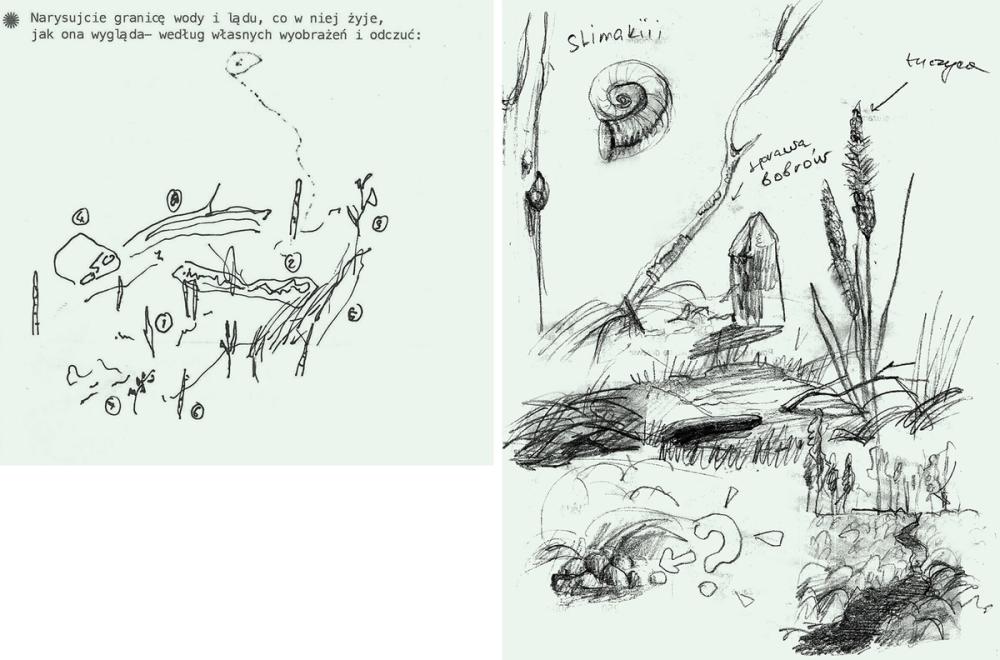
Field notes from a community inventory of amphibians (2024) Left: Draw the boundary between water and land, what lives in it, what it looks like—according to your own imagination and feelings. Right: Sketches from the observation point (52°13'47.2"N 21°07'25.9"E) on the border. © Zakole
Denying sentience to more-than-humans renders them objects that can be displaced, removed, downsized, and ignored. A ‘more-than-human right to the city’ expands the scope of a socio-political concept of ‘right to the city’ with multispecies city dwellers. It specifies the more-than-human right to the city as: the right to access the space and resources, to occupy the space, the right to active consideration in urban social and political decision-making processes. This concept is helpful to understand and deeply consider the needs and interests of the more-than-human residents in urban planning and decision making. It sees the agency and opinions of other species as equally important to ours and highlights their right to territory, free movement and basic needs being met.
There is a paradoxical gap between the ongoing mass extermination of amphibians and the strong legal prohibition on interacting with them and touching them, as it requires permits from The Regional Directorate for Environmental Protection (RDOŚ) that are granted mostly to specialists. At the same time, the fish stocking of ponds, which can effectively exterminate the entire amphibian population in a given reservoir takes place without effective legal supervision. The same applies to the burying of small water bodies located on private land, as was the case of the disappeared basin number 19, a former habitat of the common spadefoot in Zakole.
Meanwhile, the memory of amphibian presence can still be summoned from childhood activities familiar to some of us, such as catching, touching, kissing frogs, and playing with tadpoles. They are being pushed aside not only by the absence of amphibians, but also by the belief that it is (legally) impossible to interact with them. Not only does this deepen the impression of distance and inaccessibility, but it also outlaws spontaneous and informal grassroot initiatives for amphibian protection, such as those that carry frogs across roads during their seasonal migrations. In this context, listening to amphibians becomes an accessible, non-invasive, and at the same time scientific method for grassroot monitoring activities or neighborhood relationship building with the more-than-human. It is also a form of mapping what escapes habitual observation and provides a different knowledge. This is because it forces us to shift our attention away from our visually-centered dominated perception of the world and seek space for deep sensory experience, embodying knowledge about the ecosystem and leaving room for imagination and speculation.
Amphíbios means „of both kinds of life”, capturing the life cycle between two habitats. „Of both” renders land and water as not opposing but allied, not dualistic but double. Amphibians are agents of two worlds and two lives which exist in parallel, which are entangled. This suspension between the aquatic and terrestrial is immanent to their existence. It points towards our understanding beyond rigid borders and beyond human life on land. Towards sensitivity to the state in between, permeability, fluidity and edges.
The double life of amphibians shows us how to go beyond oppositions sanctioned in Western culture such as urban and wild, human and animal, past and future.
They are wild critters dwelling cities just as we do, following an evolutionary lineage of first vertebrates that crawled out of water and an animal group fastest disappearing from Earth, foreshadowing an empty future.
Would you lay your eggs here?—asks one group during our grassroots amphibian inventory at Zakole Wawerskie. The question was a helpful prompt in the assessment of the inventory spots. What are the qualities of making a basin and its surroundings a potential spawning place? What conditions make up for a hospitable and safe future? Such a perspective enables thinking-with frogs and toads. Thinking about their presence with its own set of needs, different but also similar to ours. Thinking between land and water, through moisture, temperature, water quality, vegetation structure, type of soil, refuge, dangers. And under THINKING hides FEELING since all these conditions need to be assessed through our senses through in-depth observation, smell, touch and listening.
Humans and amphibians meet in very different bodies, at different time scales, and even in different worlds. Co-habitating demands an attempt to understand other modes of living. Our special tool in approaching such a relationship is one that we need to cultivate carefully everyday—the art of noticing and attentiveness. Only through stretching our cognitive muscles, softening our gaze, slowing our walking pace, and developing curiosity to other scales and worlds can we let our common story unfold.
My noticing of the absence calls for grief but also for hopeful gestures—so I keep listening and responding, even if I can’t hear them at all. I start making both well-studied and imagined frog noises, a practice which started from personal amusement but became a way of digesting ecological uncertainties collectively. We croak and gurgle, calling frogs in their language in hopes to lure them in, asking for their comeback. We will keep doing so if they won't, reminding of their disappearance.
Continuous listening to the absence is not just about gathering evidence, completing the record, collecting proof, but rather a place where, over time, we start storing memory of these animals within our bodies; open to the possibility that we are wrong about their disappearance, or that nothing is set in stone. Participating in the sonic space and taking this space to make noises, sing and hear our voices in chaotic resonance with others is where everyday mourning can happen. An exchange of deep affiliation moving as sound waves tickling the cilia of our cells, flowing in and out of our fluid-filled, inner ears.