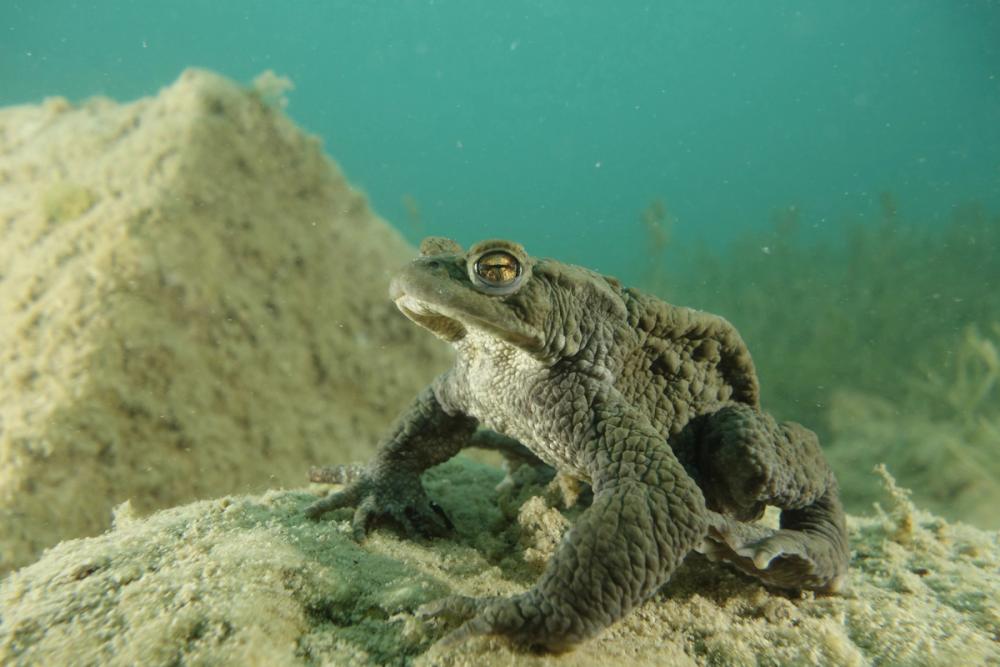
Niklaus Peyer, you have been engaged as a herpetologist in Switzerland for many years. What can we as individuals do to better protect and promote amphibians in our gardens or the urban neighborhood?
Quite simply: allow for more messiness. Don’t remove all the leaves, and really avoid constantly trimming the lawn or meadow. Leave piles of leaves and branches, and let some wild growth happen here and there. It’s essential to avoid slug pellets and other pesticides. And, very importantly: have the courage to leave gaps in fences, walls, or privacy screens so small animals can pass through. Above all, though, make sure to eliminate hazards for small wildlife—for example, by adding adequate escape structures to light wells and drainage shafts or by covering them with grates.
Amphibians have a highly sensitive skin. If someone finds an animal—for example on a frequented road—and wants to help—how should it be touched and transported?
In such a case, it’s important to carefully reflect whether the animal really needs to be carried, or whether it can continue its way on its own. If help is truly necessary, gently pick it up with your hands, using a net, a box with a lid (such as a plastic container or a shoebox), or even a small shovel and brush to prepare it for a transport. If the animal must be touched, please do so with great care and as little pressure as possible. The more firmly you try to hold it, the more it will struggle to escape. Newts, in particular, should ideally only be held by the tail when being lifted, as this minimizes their risk of injury. Alternatively—as is also the best way for frogs and toads—you can form a kind of “cave” with both hands and gently enclose the animal that way.
HOW TO TRANSPORT AMPHIBIANS IN A CONTAINER
- Keep the animals cool, yet protected from frost. Take care to avoid overheating.
- For short journeys, neither food nor water is necessary.
- Air holes must be very small for newts and are usually not needed for short transports.
- Fill the transport container with hiding places (leaves, moss, tufts of grass).
- The environment should never be completely dry, but for short transports, a large amount of water is usually not necessary. An exception is frogs in buckets: to prevent them from jumping out, the bucket should be filled with 10–15 cm of water.
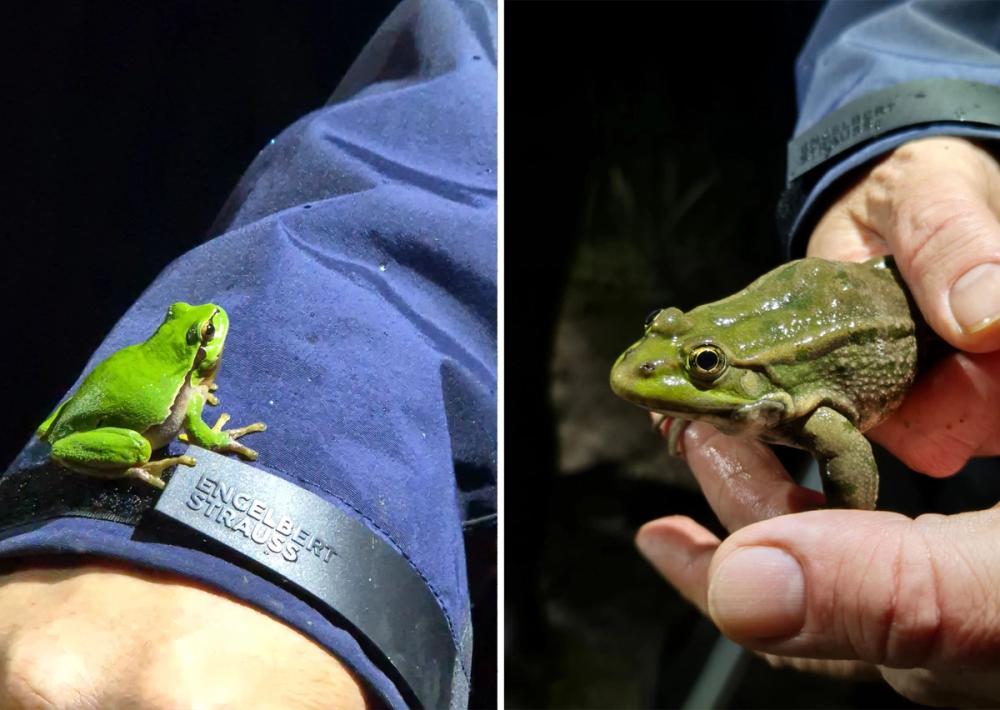
left: European tree frog (Hyla arborea). © Sophie Büchi.
right: Niklaus Peyer gently holding an individual of the water frog complex (Pelophylax agg.). © Davide Köpfli.
Can one carry amphibians by hand or would potential remains of sun screen or skin cream harm them? And on the other side, does one need to take care because of amphibian toxins?
The skin toxins of our native amphibians are not dangerous. If you touch your mouth or eyes after handling the animals, you may experience a slight burning sensation, but this will disappear again after a short time. For this reason, wearing gloves while carrying amphibians is not really recommended. Certain coatings on gloves may even potentially harm amphibian skin. To reduce the risk posed by sunscreen, skin creams, perfumes, etc., and above all to prevent the transmission of often deadly diseases (pathogens), hands should be washed regularly. This also applies strictly to any equipment used, such as nets, buckets, and similar items. Before visiting another site or pond, everything should be thoroughly cleaned and disinfected.
If an amphibian is found far away from its natural living environment, for example in a basement – where should I bring it? And is it a good idea to carry amphibians or spawn to a nearby biotope?
The animal should be moved to a safe place, but as close as possible to where it was found. Ideally, it should be released in a well sheltered spot—beneath a hedge or shrub, within a pile of leaves, branches, compost, or stones, beside a dry-stone wall, or at the edge of a woodland. If spawn is discovered in a location that seems about to dry out—a small puddle for instance, it is generally best to allow nature to take its course. It is natural that a certain amount of spawn dries out during periods of drought, and this happens repeatedly. Amphibians can usually compensate for such losses in “good” (wet) years. If the same body of water also offers deeper areas, the spawn can be carefully moved. However, transporting it to other habitats is not recommended. It again carries a risk of spreading diseases (pathogens), and a well-meaning action could potentially harm populations at both sites.
CAUTION: INFECTIOUS DISEASES
- To prevent the spread of infectious diseases—many of which can be fatal to amphibians—all equipment (rubber boots, nets, capture containers, etc.) must be properly treated after each use.
- Allow all equipment and boots to dry completely. Dirt on shoe soles must also be thoroughly dried.
- Boil equipment (5 minutes at 60 °C is sufficient).
- Disinfect: use for example, undiluted bleach, 70% alcohol, or Virkon S.
- Do not carry out disinfection near bodies of water.
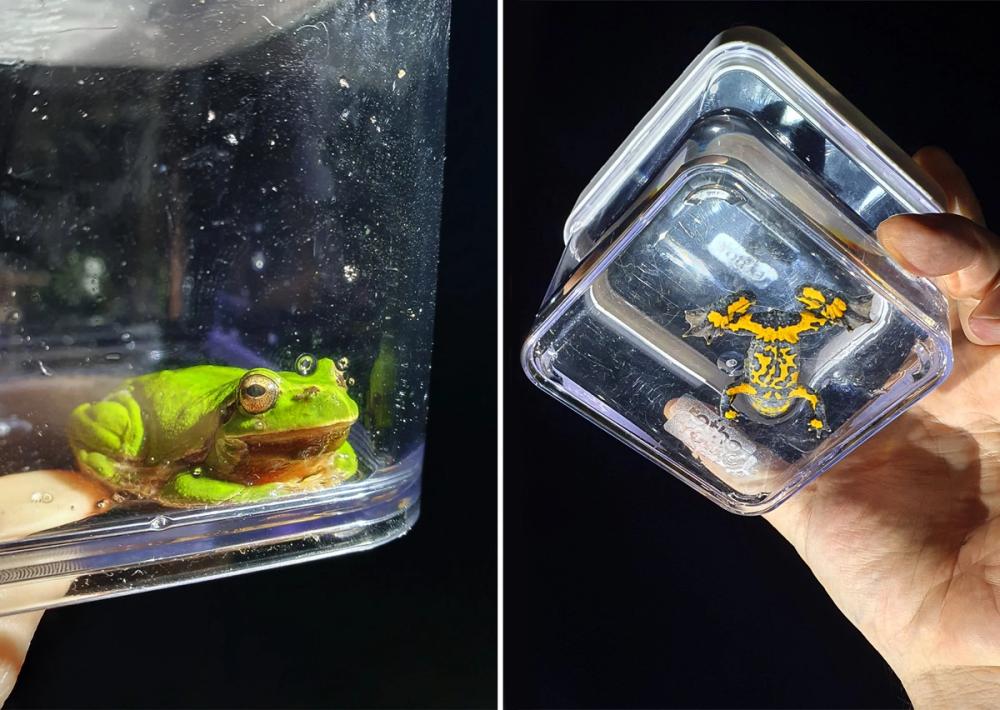
European tree frog (Hyla arborea) and yellow-bellied toad (Bombina variegata), both presented in a display box during an evening excursion, before being released again. © Sophie Büchi.
In springtime many amphibians migrate. How can I assist the local migration?
During amphibian migration, support is possible on several levels. Problem areas—such as roadkill or hazardous traps—should definitely be reported (for example via lepus.infofauna). In addition, the Swiss database of amphibian migration sites provides an overview of conflict zones between amphibian movements and traffic, along with related rescue statistics. This platform allows interested individuals to learn more about efforts to protect amphibians during their seasonal migrations and to find out how they can contribute. Many municipalities also rely on volunteers each spring. More information on how to get involved in amphibian migration efforts in your region can be found here.
If I find or observe an amphibian somewhere, could or does it need to be registered?
Yes, this is the only way to keep distribution maps up to date and to understand whether specific species are doing well or declining. By reporting your faunistic observations to the national data and information centre info fauna, you actively contribute to nature and species conservation in Switzerland. Observations can also be recorded via other platforms such as Ornitho or Stadtwildtiere.ch. These records are then forwarded to info fauna.
How can I learn more about amphibians in Switzerland?
KARCH and various local nature conservation organizations regularly offer introductory and advanced training courses that can be attended in many regions of Switzerland. For instance, the introductory course at Infofauna or the training and continuing education courses in species identification at infospecies.ch
For self-study, learning quizzes—such as those provided by Biofotoquiz—are a useful option. When out in the field, the Webfauna app can also be very helpful (observations can also be reported directly through the app). Developed by info fauna, it offers free identification keys for amphibians (both tadpoles and adults), as well as dragonflies, butterflies, burnet moths, reptiles, and mammals in Switzerland.
HELPFUL LINKS
Amphibienschutz vor der Haustür A publication by infofauna on amphibians in urban areas; about how to create amphibian-friendly environments; avoid traps; recommendations for maintenance and materials.
Ausstiegshilfen und Amphibienleitern Informations of infofauna on various models of escape objects for amphibians in drainage shafts are available.
Tierfallen in Haus, Garten und Landschaften vermeiden This practical guide from BirdLife Switzerland’s “BirdLife aktiv” series highlights the traps that animals face in urban areas and other cultivated landscapes, and explains how to mitigate them.
Barrieren und Fallen für Kleintiere vermeiden Information provided by Pro Natura on barriers and traps for small animals in urban areas. We are often unaware of these, but they can be mitigated with minimal effort. Wildtiere vor der Haustür A document provided by Pro Natura about many small and larger animal species that use urban areas as part of their habitat. Amphibien rund ums Haus A brochure by Pro Natura suggesting what we can do to protect and support amphibian species in our close neighborhood.